There is a frustrating catch-22 in building anything meaningful: it is easier to join good projects once you have proof, but it is hard to create proof without getting the chance to work on good projects.
The same problem shows up for founders, students, early-career builders, career switchers, artists, designers, engineers, organizers, and people with half-formed ideas. You may want to build something real, but you do not know where to start, who to build with, or how to make the work visible enough to matter.
Heirloom Originals are our answer to that problem.
An Original is a scoped starter project hosted on Heirloom. It gives people a concrete place to contribute, a public record of what gets shipped, and a contribution history that can support shared ownership if the team later decides to formalize the project.
Why Originals exist
A lot of people do not need another inspirational post telling them to start. They need a smaller first step.
Starting from a blank page is hard. You have to choose the idea, define the scope, find collaborators, create the first tasks, keep momentum alive, and decide how credit or ownership will work if the project becomes serious. That is a lot to solve before anything has even been built.
Originals lower the activation energy. Instead of asking every builder to invent the entire structure from scratch, Heirloom seeds projects with a clear purpose, simple first tasks, a demo rhythm, and contribution tracking from the beginning.
The goal is not to make people work for Heirloom. The goal is to create better on-ramps for people who want to build with others but need a real place to begin.
Companion read: For the broader reason Heirloom exists, start with Why Now Is the Time to Build Together.
What is a Heirloom Original?
A Heirloom Original is a starter project created or curated by Heirloom so builders have something real to join. It is not a fake job listing, a bounty board, or a vague Discord channel. It is a project with enough structure to make progress possible.
Every Original should have:
- A clear premise: what the project is trying to become and why it might matter.
- A small first milestone: something the team can ship quickly instead of debating forever.
- Open roles: the kinds of contributors the project needs right now.
- Visible tasks: work that can be claimed, completed, reviewed, and credited.
- A steward: someone responsible for keeping the project legible, reviewing progress, and helping new contributors get oriented.
- A contribution record: a ledger of who did what, when, and with what outcome.
The point is to make collaboration easier without pretending the project is already a company, a formal co-op, or a finished organization.
Who Originals are for
Originals are for people who want to do real work but are not sure how to find the right project or team.
That could mean:
- A developer who wants to ship something more interesting than another tutorial project.
- A designer who wants a real product, community, or brand system to shape.
- A student who wants proof of work before applying for roles, fellowships, or accelerators.
- A founder-type person who wants to test an idea with others before turning it into a company.
- A community builder who wants to help organize people around a shared interest.
- A creative person who wants to join a studio, collective, or project without having to start alone.
Originals are especially useful for people who care less about credentials and more about building a body of visible work.
How an Original works
The basic flow is simple:
- Browse Originals. Find a project that matches your interests, skills, or curiosity.
- Read the project charter. Understand the purpose, current milestone, open roles, and contribution rules.
- Request to contribute. Share what you want to help with and how much time you realistically have.
- Claim a first task. Start with something small enough to finish and visible enough to matter.
- Ship the work. Submit the artifact, demo, design, write-up, code, research, or other output.
- Get the contribution recorded. Accepted work becomes part of the project history and your personal proof of work.
- Keep going, lead, or branch off. If the team clicks, continue. If you see a better direction, start a new Loom and bring others with you.
The first task matters. It should be small enough to complete quickly, but real enough that the project is better because you did it.
What you actually leave with
The immediate value of an Original is not a promise that the project will become a company. Most early projects will not. The immediate value is proof.
A good Original should help you leave with:
- Shipped artifacts: work you can point to, not just describe.
- A public project history: what the team tried, what changed, and what got built.
- A contribution record: tasks, dates, outcomes, and accepted work tied to your profile.
- Better collaborators: people you have built with, not just chatted with.
- A clearer next step: continue the Original, fork the idea, start a new Loom, or take the proof into your next opportunity.
This is bigger than a portfolio piece, but it should still be useful even if the project never becomes anything formal.
How ownership works in an Original
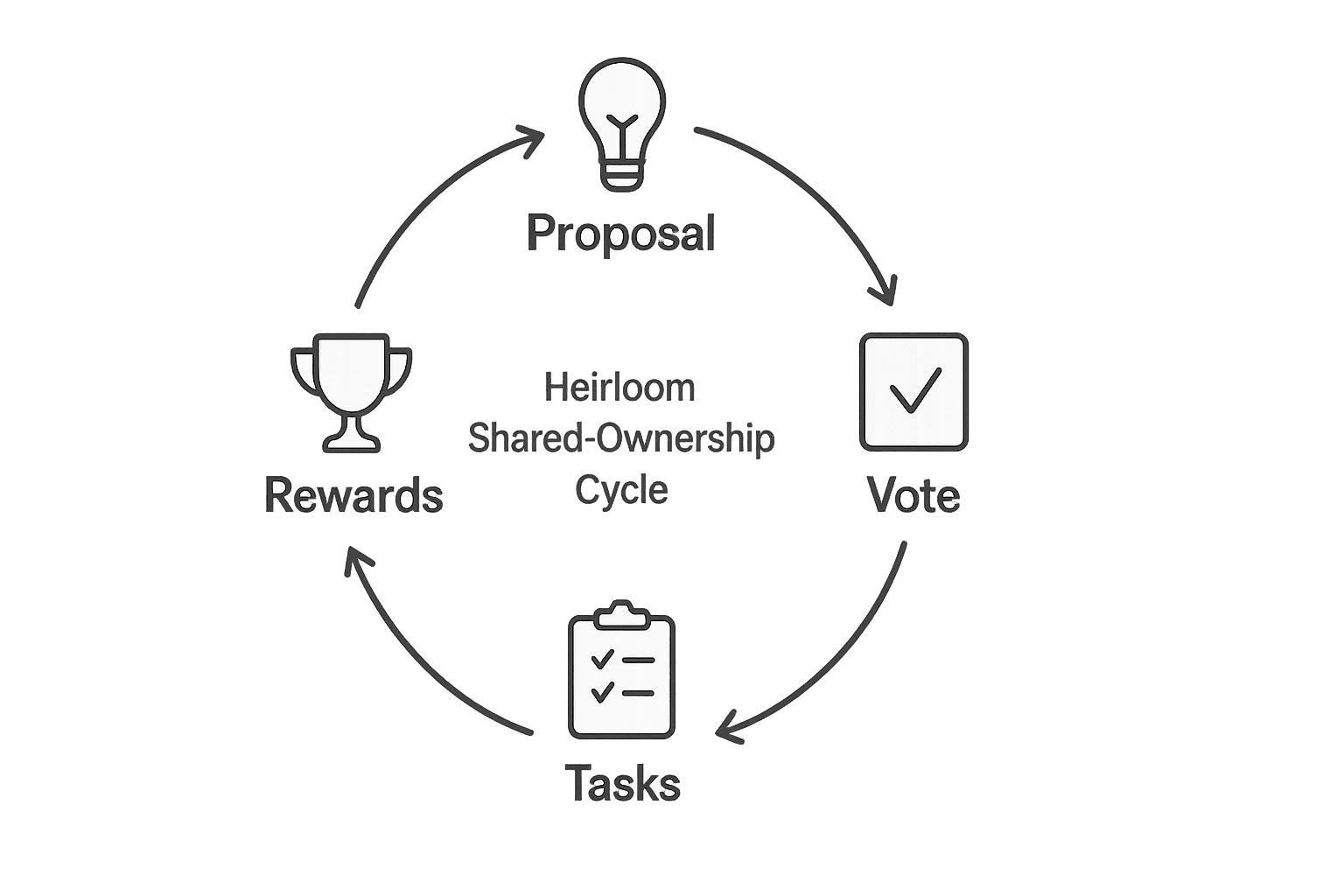
Originals use the same basic principle as Heirloom's dynamic-equity model: contribution should be visible before ownership is promised.
When you complete accepted work, that contribution is recorded. Depending on the project, the record may include tasks shipped, role, complexity, time, outcomes, demos, decisions, or other agreed-upon signals.
If the Original stays informal, that record still matters. It is proof of work, proof of collaboration, and proof of momentum.
If the team later decides to formalize the project as a company, cooperative, collective, revenue-sharing project, or other legal structure, the contribution history gives the team a more honest starting point for deciding who should own what.
That distinction is important. Heirloom does not turn every task into legal equity automatically. It helps teams build the record they will need if ownership becomes real later.
Related: For the full ownership model, read Build Together, Own Together.
Why this is not spec work
This question matters, and we should be direct about it.
Spec work usually means someone asks you to create value for them without fair compensation, clear rights, or a meaningful path to benefit from the outcome. That is not what Originals are meant to be.
Originals need guardrails to stay honest:
- No hidden client: an Original should not be a disguised way to get free work for a private customer.
- Transparent rights: contributors should know what happens to their work before they contribute.
- Visible credit: accepted contributions should be tied back to the person who did the work.
- Portable proof: contributors should keep a record they can use even if the project ends.
- Clear opt-in: people choose projects because they care about the work, the learning, the team, or the potential upside.
- A path to ownership if formalized: if the team turns the work into a formal venture, prior contribution should be part of the conversation.
The standard is simple: contributors should not feel like they donated value into a black box. They should understand the project, the rules, the rights, and what they can take with them.
What stewards are responsible for
Every Original needs someone keeping the project from becoming a graveyard.
A steward is not a boss in the traditional sense. They are the person responsible for making the project legible and helping contributors find useful work.
A good steward should:
- Keep the project charter up to date.
- Break vague goals into clear tasks.
- Review contributions on a predictable cadence.
- Welcome new contributors and point them toward first tasks.
- Archive or pause the project if momentum disappears.
- Help identify when a contributor is ready to lead, fork, or steward part of the project themselves.
Over time, stewardship can transfer. If someone consistently ships, understands the project, and earns trust, they should be able to take on more responsibility.
What the first week should feel like
The first week of an Original should be lightweight. You should not need to understand the entire future of the project before contributing.
A good first week looks something like this:
- Day 1: join the Loom, read the charter, and introduce yourself.
- Day 2: pick a small starter task or ask the steward where help is most useful.
- Days 3–5: work on the task, ask questions, and post progress.
- Day 6: submit the work or demo what changed.
- Day 7: get feedback, have the contribution recorded, and decide whether to keep going.
The first win does not need to be huge. It needs to be real.
For people with ideas
Originals are not only for contributors looking for projects. They are also useful for people with ideas who are not ready to build alone.
If you have an idea but no team, you can start a Loom, define a small first milestone, and invite people into the work before pretending you have a company. Heirloom helps you make the idea concrete enough for others to understand, join, and contribute.
That requires humility. If other people help build the idea, they should not be treated as interchangeable helpers. They are contributors. If the project becomes real, the ownership conversation should reflect the people who made it real.
Originals are one way to practice that from the beginning.
For schools, clubs, accelerators, and communities
Originals can also work as a lightweight project layer for communities that want members to do more than attend events.
A school, club, bootcamp, co-op network, or local ecosystem group could use Originals to help members form teams, ship projects, create visible proof, and continue beyond a single workshop or cohort.
The value is not just “engagement.” It is continuity. People leave with something built, a record of how they contributed, and a clearer path to keep collaborating after the program ends.
The quality bar
Originals only work if they are maintained. A page full of dead projects is worse than no page at all.
That means Heirloom should be willing to keep the number of Originals small. Quality matters more than quantity.
A project should be paused or archived if:
- No one is reviewing contributions.
- The charter is unclear or misleading.
- There are no useful starter tasks.
- Contributors are shipping work but not receiving feedback.
- The rights or ownership expectations are unclear.
- The project no longer has a steward.
The promise of Originals is not that every project will succeed. The promise is that contributors should not be left guessing whether their work mattered.
Common questions
Is an Original a job? No. Originals are voluntary starter projects. They are not employment, and they should not be presented as guaranteed compensation.
Do I automatically get equity? No. Completed work creates a contribution record. If the team later forms a company, co-op, or other legal structure, that record can help inform ownership. Actual equity or membership rights require formal agreements.
What if the project dies? The project can be archived, but your contribution history and shipped work should remain useful as proof of what you built.
Can I start my own project instead? Yes. In fact, that is part of the point. Originals help people get into motion, but they should also help new ideas and teams spin out.
Who owns the work? Each Original should state its rights and licensing expectations clearly. The safest early version is transparency: contributors should understand what they are contributing to before they start.
How much time should I commit? Start small. Most people should begin with a task they can finish in a few hours. Momentum matters more than overcommitting.
The spirit of the thing
Heirloom Originals come from a simple belief: more people should have access to meaningful things to build.
Not everyone has a polished startup idea. Not everyone has a cofounder. Not everyone has a network that hands them the right opportunity at the right time. But many people are capable of doing excellent work once they have a real project, clear next steps, and people to build with.
Originals are meant to create that opening.
If all you leave with is a stronger portfolio piece, a few good collaborators, and a clearer sense of what you like building, that is already valuable. If the project grows into something larger, the contribution history gives the team a fairer way to talk about ownership.
Either way, the work should not disappear.
Find a real project to build on
Request early access to Heirloom and work with us to shape a workspace around real coordination needs.
Request Early AccessHeirloom provides collaborative tools and templates to help teams organize work, decisions, and contribution history. Originals are not employment, legal equity grants, investment offers, or legal advice. If a project becomes a formal company, cooperative, nonprofit, or other organization, contributors should use appropriate legal agreements and consult counsel.