Every early project eventually runs into the same uncomfortable question: if this works, who owns what?
It sounds like a legal question, but at the beginning it is usually a trust question. Someone had the original idea. Someone else built the first prototype. Another person found the first users, designed the landing page, ran the community, paid for tools, made introductions, or kept the project moving when everyone else got busy.
Traditional equity asks teams to answer that question before they have enough information. Dynamic equity starts from a different premise: do not pretend you know the final split on day one. Track what people actually contribute, make the rules clear, and let ownership emerge from the work.
That is the idea behind Heirloom's shared-ownership model.
Why fixed early splits break down
Fixed founder splits feel clean because they give everyone an answer. The problem is that the answer is often based on hope. You are guessing how much each person will contribute before the project has revealed what it needs, who will stay committed, or whose work will become most important.
Noam Wasserman's work on founder equity is useful here because it shows how common this mistake is. In his founder equity material, he notes that many teams split equity within the first month, when huge uncertainties about commitment, roles, pivots, and future contribution are still unresolved.
The emotional cost is obvious. If someone leaves early with a large stake, the people still doing the work feel punished. If someone joins later and creates enormous value, the team may have no clean way to reward them. If everyone avoids the conversation, resentment builds quietly until the project starts to feel unfair.
This is why vesting exists in startups. It is also why contribution-based ownership is so compelling before a company even exists. Early teams need a way to stay fair while reality is still changing.
Companion read: If you want the broader philosophical case for this moment, start with Why Now Is the Time to Build Together.
What dynamic equity means
Dynamic equity means ownership is not treated as a one-time guess. It adjusts as people contribute. The underlying principle is simple: your share should reflect your share of the project's at-risk contributions.
The best-known public framework for this is Slicing Pie, which turns unpaid or underpaid contributions into a normalized unit called a slice. The exact implementation can vary, but the central idea is useful: time, money, relationships, equipment, ideas, and other unpaid contributions can be tracked as risk people are taking on behalf of the project.
Heirloom adapts that spirit for collaborative projects, co-ops, small teams, and early ventures that may not know their final legal form yet. Instead of forcing a permanent split too early, Heirloom helps teams create a contribution record that can later inform founder grants, member shares, a cooperative structure, revenue participation, or another formal agreement.
The point is not to avoid legal structure forever. The point is to avoid pretending the legal structure should come before the team has evidence.
How Heirloom's version works
On Heirloom, a project lives inside a Loom. A Loom gives the team a shared place to define the idea, invite collaborators, organize work, make decisions, and track contributions over time.
A healthy dynamic-equity setup has five parts:
- Contribution categories. The team defines what counts: shipped work, design, customer discovery, operations, community work, recruiting, capital, IP, or other valuable inputs.
- Weighting rules. The team agrees on how different types of contribution are valued before disputes happen.
- Evidence. Contributions are tied to visible artifacts: completed tasks, shipped features, meeting notes, customer calls, designs, commits, posts, decisions, or other proof.
- Review cadence. The ledger is reviewed regularly so mistakes, disputes, and unclear expectations do not sit unresolved for months.
- Formalization trigger. The team defines when the dynamic record hardens into a real agreement: revenue, incorporation, funding, payroll, a cooperative formation step, or another serious milestone.
This is the difference between "we'll figure it out later" and "we are building a record we can trust later."
A simple example
Imagine three people start a project together.
One person brings the original idea and spends ten hours interviewing users. Another builds the first prototype over two weekends. A third designs the landing page, writes the first outreach emails, and finds three interested pilot users.
In a fixed split, the team might casually choose 50/25/25 or 33/33/33 because it feels peaceful in the moment. But after six weeks, the reality may look very different. Maybe the prototype work became the bottleneck. Maybe customer discovery mattered more than expected. Maybe the person who had the idea became less available. Maybe someone new joined and immediately unlocked distribution.
Dynamic equity lets the team respond to that reality. Each accepted contribution is logged. The ledger changes as the work changes. If the project never becomes formal, everyone still has a record of what they built. If the project does become formal, the team has a principled starting point for the ownership conversation.
What the research says about shared ownership
Dynamic equity is an early-stage mechanism, but it sits inside a much older and better-studied tradition: shared ownership. Employee ownership, profit sharing, gain sharing, broad-based stock options, ESOPs, and worker cooperatives all approach the question differently, but they share a common belief that people behave differently when they participate in the value they help create.
The research does not say that ownership magically fixes a bad organization. The more precise lesson is stronger: ownership works best when paired with participation, information sharing, trust, and real voice. This is why Heirloom treats ownership tracking and governance as connected systems rather than separate features.
That matters for early projects. If people can see the work, see the decisions, understand the rules, and trust that contribution will be recognized, collaboration becomes easier to sustain. Ownership becomes less of a prize to fight over and more of a record of what the team actually built together.
Deeper read: For the research-heavy version of this argument, see Why Shared Ownership Resonates.
Dynamic equity, ESOPs, and worker co-ops are not the same thing
One mistake people make is treating every ownership model as if it solves the same problem. It does not.
| Model | Best for | Main limitation |
|---|---|---|
| Fixed founder split | Very small founding teams with unusually clear roles and commitment | Can become unfair quickly if contribution changes |
| Vesting-based founder stock | Incorporated startups with a defined founding team | Still begins from an initial guess about ownership |
| Dynamic equity | Early projects where contribution, roles, and commitment are still uncertain | Needs disciplined tracking and later formalization |
| ESOP | Established businesses, succession, or broad-based employee ownership | Complex and usually later-stage; not the same as democratic control |
| Worker cooperative | Teams where democratic ownership and governance are core to the mission | Requires member commitment, governance maturity, and clear operating agreements |
Heirloom is most useful before the team knows which path it will take. It helps preserve the contribution history that can inform the later structure.
The guardrails matter
Dynamic equity only works if people trust the rules. Without guardrails, it can become just another vague promise.
Here are the guardrails I think every early team should define:
- What counts as contribution: Do ideas count? Does recruiting count? Does unpaid time count? What about money spent on tools?
- Who accepts completed work: A task should not automatically become ownership credit just because someone says they did it.
- How disputes are handled: Contributors need a simple way to challenge a missing or misweighted contribution.
- How people leave: The team should decide what happens to unvested, inactive, or abandoned contributions.
- When the ledger freezes: The team needs a clear trigger for converting the dynamic record into a formal agreement.
- What requires a vote: Ownership changes, major pivots, fundraising, IP decisions, and legal formation should not happen casually.
The goal is not to make the team bureaucratic. It is to make fairness boring enough that people can focus on building.
The Heirloom flow
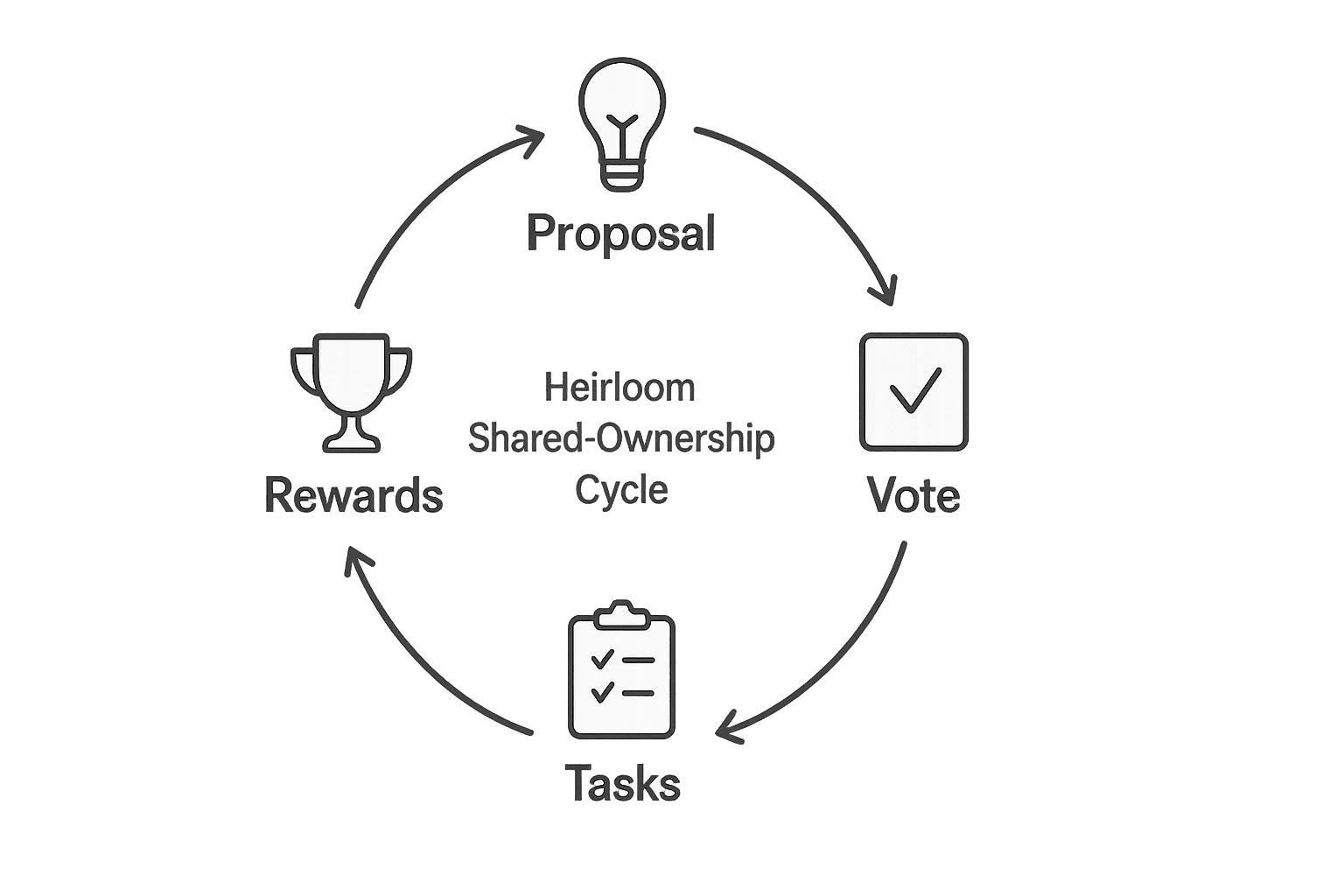
A healthy shared-ownership workflow on Heirloom looks like this:
- Create the Loom. Define the idea, purpose, current stage, and what kind of collaborators are needed.
- Set the ownership norms. Choose contribution categories, weighting principles, and review cadence.
- Break work into tasks. Make contribution visible through concrete work, not vague enthusiasm.
- Review and accept contributions. Track what was completed, who did it, and how it maps to ownership points.
- Use proposals for major decisions. When the decision affects the project's direction or ownership, give contributors a clear voice.
- Formalize when the project is ready. When the team reaches a serious trigger, export the contribution history and work with counsel or advisors to create the right legal structure.
Related: For the decision-making side of this system, read Choose Together, Build Together.
What dynamic equity is not
Dynamic equity is not a loophole to avoid paying people. If a team can pay contributors fairly, it should. The model is most useful when people are knowingly taking early risk together because the project does not yet have the cash, structure, or certainty to compensate everyone normally.
It is also not legal magic. A contribution ledger is not the same thing as issued stock, a cooperative membership agreement, an ESOP, or a binding equity plan. Teams still need proper legal documents when they formalize.
And it is not a substitute for trust. It is a way to make trust easier to maintain by reducing ambiguity. If people do not communicate clearly, review contributions honestly, or resolve disputes in good faith, no ownership model will save the team.
A checklist for early teams
Before using dynamic equity, answer these questions together:
- What are we trying to build?
- Who is currently contributing?
- What kinds of work should earn ownership credit?
- How will we value different types of contribution?
- Who decides whether work is accepted?
- How often will we review the ledger?
- What happens if someone stops contributing?
- What decisions require a vote?
- What event causes us to formalize the ownership structure?
- Who will help us create the actual legal documents when that happens?
If a team cannot answer these questions, it probably is not ready to promise anyone ownership. But it may be ready to start tracking contribution.
Ownership should follow the work
The deeper belief behind Heirloom is not that every project needs to become a startup, a co-op, or an employee-owned company. It is that people should not have to build in systems where contribution disappears.
If you help create something valuable, there should be a fair record of that work. If a project grows, the people who carried it forward should have a principled path to share in what they helped build. If the project ends, they should still have proof of contribution, relationships, and learning they can carry into the next thing.
That is what dynamic equity is trying to protect: not just a future payout, but the dignity of knowing that the work mattered.
Start with contribution, not guesses
Create a Loom, define the work, invite collaborators, and start building a contribution history your team can trust.
Request Early AccessHeirloom provides collaborative tools and templates to help teams organize work, decisions, and contribution history. Nothing on this page is legal, tax, or investment advice. If you choose to incorporate, issue equity, form a cooperative, adopt an ESOP, or create another ownership structure, consult appropriate counsel.
Sources and further reading
- Kruse, Freeman, and Blasi, Shared Capitalism at Work.
- National Center for Employee Ownership, research findings on employee ownership.
- U.S. Department of Labor, employee ownership overview.
- Internal Revenue Service, ESOP definition and guidance.
- Slicing Pie, dynamic equity model overview.
- Kauffman Entrepreneurs / Noam Wasserman, founder equity splits.
- Cooley GO, founder stock, vesting, and founder departures.