A lot of people are carrying ideas they may never build.
Not because the ideas are bad. Not because they lack imagination. More often, the idea simply has nowhere to go. It lives in a notebook, a late-night conversation, a half-finished document, or the back of someone's mind while work, bills, school, family, and normal life keep moving.
The strange thing is that starting has never looked more accessible. You can publish a website in an afternoon, learn a new skill online, share work with strangers, and find tools for almost anything. But for many people, the hardest part is not access to software. It is finding the structure, people, and confidence to turn an idea into something real.
That is the gap Heirloom is built around.
Ideas usually do not die all at once
They fade quietly.
At first, the idea feels exciting. You can imagine what it could become. Maybe it is a product, a community, a creative project, a local organization, a co-op, a studio, a tool for your own work, or just a better way of doing something you have seen go wrong too many times.
Then the practical questions arrive. Who would help? Where would the work live? How would you keep people moving? What happens if someone contributes a lot early and someone else shows up later? Who owns the thing if it starts to work?
Those questions can feel premature, so people avoid them. But avoiding them does not make them disappear. It usually just means the project stays informal until the informality becomes the reason it stalls.
The default path is still too lonely
We still talk about building as if the natural unit is one heroic person with enough discipline to figure everything out alone. That story is appealing, but it is not how most good work actually happens.
Most meaningful projects are built through relationships. They need feedback, trust, disagreement, coordination, and people with different strengths. The person with the idea may not be the best designer, engineer, operator, writer, salesperson, community builder, or organizer. That should not kill the idea.
But collaboration introduces its own friction. If the project is too casual, nobody knows what is actually expected. If it becomes too formal too quickly, it starts to feel heavy before it has earned that weight. If ownership is ignored, resentment can grow quietly. If ownership is decided too early, the split may age badly once the real work begins.
That is the uncomfortable middle space where many early projects get stuck: too real to be treated like a casual brainstorm, but too early to become a company, co-op, or formal organization.
Existing tools were not built for the fragile beginning
There are plenty of tools for managing work once a team already exists. There are tools for tasks, documents, chat, fundraising, hiring, payments, and project management. They all help with pieces of the problem.
But the earliest stage has a different shape. The team may still be forming. The roles may still be unclear. The commitment level may be uneven. The project may not yet know whether it wants to become a business, a community, a co-op, a nonprofit, or something else entirely.
In that stage, what people need is not just another place to put tasks. They need a shared home for the idea, the people, the work, the decisions, and the contribution history. They need enough structure to keep going without turning the project into bureaucracy before it has even started.
Related: For a more practical breakdown of how ownership can emerge from real contribution, read Build Together, Own Together.
Why now?
The relationship people have with work is changing. More people are questioning whether the default path is enough. Some want more autonomy. Some want more meaning. Some want to build something outside the narrow shape of a traditional job. Some are looking at a changing economy and realizing that stability may not come from waiting for institutions to hand them a clear path.
At the same time, technology has made it easier for small groups to create things that used to require far more capital, permission, or infrastructure. A small team can build software, publish media, organize a community, start a local initiative, launch a studio, or test a new business faster than ever.
The opportunity is real, but so is the missing layer. More people can start, but starting is not the same as sustaining. The hard part is turning scattered energy into coordinated progress. The hard part is helping people find each other, stay aligned, and share the upside in a way that feels fair.
That is why this moment matters. We do not just need more tools for individual productivity. We need better ways for people to build together.
What Heirloom believes
Heirloom is built around a simple belief: good ideas need more than motivation. They need people, structure, accountability, and a fair way to recognize contribution.
A project should have a place where the idea can become legible. Contributors should be able to see what needs to happen next. Decisions should not disappear into scattered messages. Work should not become invisible the moment it is finished. Ownership should not depend only on who happened to be in the room at the beginning.
That does not mean every project needs to become a startup. It does not mean every group needs a complicated governance system. And it definitely does not mean software can replace trust. But the right structure can make trust easier to build.
It can make expectations clearer. It can make contribution more visible. It can make the first serious step feel less lonely.
What this looks like in practice
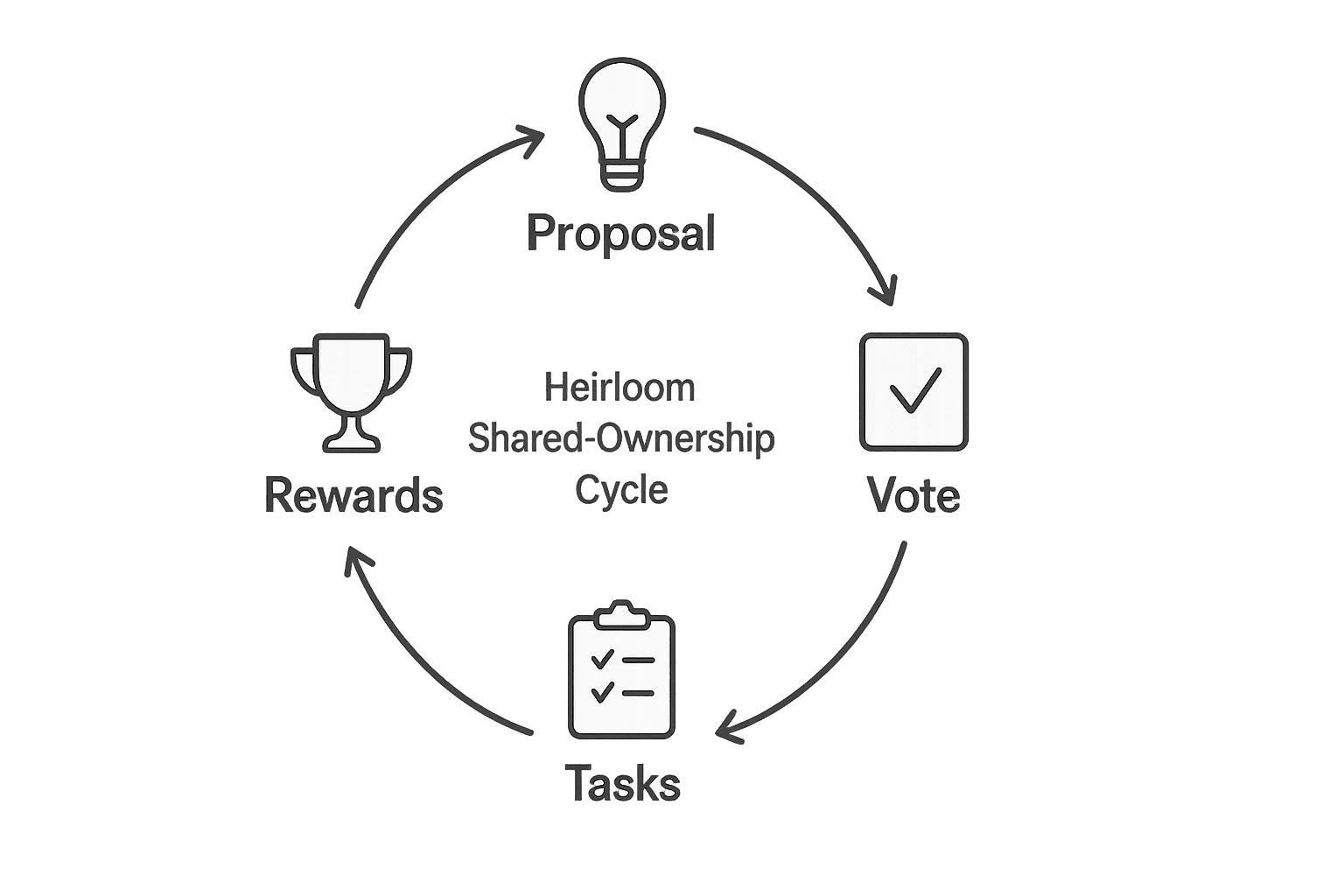
On Heirloom, a project lives inside a Loom. A Loom gives the team a shared space to organize the idea, invite collaborators, coordinate work, discuss decisions, and track what people contribute over time.
For some teams, that might mean a small creative project with a few people contributing when they can. For others, it might mean an early co-op, a founder-led project, a student group, a community initiative, or a mission-driven team that needs a lighter way to stay aligned.
The common thread is not the legal structure. It is the belief that people should be able to build with others without losing the work, context, and contribution history that make the project real.
What this is not
This is not about turning every idea into a venture-backed startup. It is not about forcing every team to become a co-op before they know what they are building. It is not about making every friendship, side project, or creative experiment feel like a legal negotiation.
It is about giving early projects enough structure to survive the fragile beginning.
Some ideas should stay small. Some should become companies. Some should become communities, collectives, programs, nonprofits, or experiments that teach people something useful before ending. That is fine. The point is not that every idea needs to scale. The point is that more people should have a real chance to find out what their idea could become.
The first step should feel lighter
I keep coming back to the same question: how many good ideas have disappeared because the person carrying them did not have the right people, structure, or confidence at the right moment?
Not all of those ideas would have worked. But some of them would have become useful tools, stronger communities, small businesses, creative projects, co-ops, research groups, or simply meaningful work that gave people a reason to keep going.
That is worth building for.
The question is not whether you are ready to build the final version. Almost nobody is. The better question is whether you are ready to give the idea a real place to grow, invite the right people in, and take the first serious step.
That is what Heirloom is here to help with.
Give your idea a place to grow
Request early access and we'll help set up a workspace around your team's real coordination work.
Request Early AccessHeirloom provides collaborative tools and templates to help teams organize their work, decisions, and contribution history. Nothing on this page is legal, tax, or investment advice. If a project becomes a formal organization, consult appropriate counsel.